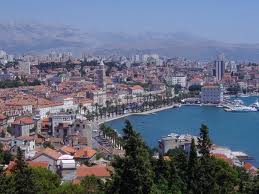
 | Split is a Mediterranean city on the eastern shores of the Adriatic Sea, centred around the ancient Roman Palace of the Emperor Diocletian and its bay and port. With a population of 178,192 citizens, and a metropolitan area numbering up to 467,899, Split is by far the largest Dalmatian city and the second-largest city of Croatia. Spread over a central peninsula and its surroundings, Split's greater area includes the surrounding seaside towns as well. An intraregional transport hub, the city is a link to numerous Adriatic islands and the Apennine peninsula, as well as a popular tourist destination. Split is also one of the oldest cities in the area. While it is traditionally considered just over 1,700 years old counting from the construction of Diocletian's Palace in AD 305, archaeological research relating to the original founding of the city as the Greek colony of Aspálathos (Aσπάλαθος) in the 6th century BC, |
century BC, establishes the urban tradition of the area as being several centuries older.
The most popular beach in Split is Bacvice, and very popular game on it called "picigin": In short, picigin is a collective game that is played in low waters normally to the ankle (rarely up to the waist), and partially on the land. Number of players is not strictly defined (as well as gender and age) although the optimal effect is achieved with 5 participants.
The most popular beach in Split is Bacvice, and very popular game on it called "picigin": In short, picigin is a collective game that is played in low waters normally to the ankle (rarely up to the waist), and partially on the land. Number of players is not strictly defined (as well as gender and age) although the optimal effect is achieved with 5 participants. As a rule, the players pass the ball only with one stroke of the palm of one hand. The size of the ball is 5-10 cm in diameter, and weight is 50-150 g. With constant hitting they try to keep the ball in the air as long as they can, before it hits the sea or the land. Apart from simple passing and keeping ball in the air the true spirit of picigin reflects in the acrobatics that participants perform, and which is also one goal of the game. Acrobations consist of players throwing themselves on to the shallow sea trying to catch the “uncatchable ball”, or the one that is almost hit sea surface or land.
In addition, one of the greatest particularities of picigin is that the players (piciginaši) do not play one against the other but together – the only non competitive sport for which I have heard. This non competitive aspect of game contributes to its attractive spirit, because in Picigin it is not important who wins but the goal is simple to have fun.
The only important equipment needed for picigin, is the ball, although you can use any ball to play the game, the true picigin players use only the heart of a tennis ball. The process of making this specific ball (balun) consists in stripping the green layer of tennis ball, and abrading the rubber part until the ball becomes thin, so that it bounces better. In order to make a balanced ball, you will have to paint the ball, before abrading so that it can be abraded equally on each side. To ensure quality work, the “professionals” balance the ball after abrading, by putting it into steady water, if it turns, the bottom part needs a little more scrubbing.
Except in Split active picigin groups exist also in Dubrovnik (beach Šunj on island Lopud), Medulinu (picigin association “Pešekan”), and on island Krk in the small town Baška, during summer you can see game played across he whole Croatian coast, but if you want to see the best picigin players in action, you will have to go to Split.
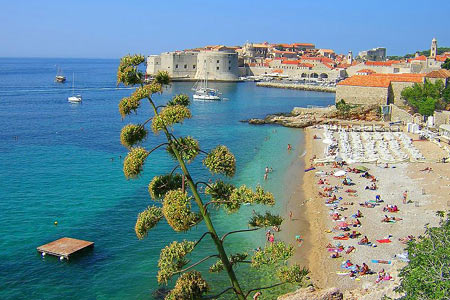 | Dubrovnik is city on the Adriatic Sea coast, positioned at the terminal end of the Isthmus of Dubrovnik. It is one of the most prominent tourist destinations on the Adriatic, a seaport and the centre of Dubrovnik-Neretva county. Its total population is 42,641 (census 2011). In 1979, the city of Dubrovnik joined the UNESCO list of World Heritage Sites. of World Heritage Sites.The prosperity of the city of Dubrovnik has always been based on maritime trade. In the Middle Ages, as the Republic of Ragusa, also known as a Maritime Republic (together with Amalfi, Pisa, Genoa, Venice and other Italian cities), it became the only eastern Adriatic city-state to rival Venice. Supported by its wealth and skilled diplomacy, the city achieved a high level of development, particularly during the 15th and 16th centuries. Although demilitarised in the 1970s with the intent of forever protecting it from war devastation, in 1991, after the breakup of Yugoslavia, it was besieged by Serb-Montenegrin forces for 7 months and received significant damage from being shelled. Most popular parts of city Dubrovnik are: stradun (Dubrovnik's main street ) , Rector's palace , The Walls of Dubrovnik with the Minčeta Tower and Onofrio's Fountain |
forces for 7 months and received significant damage from being shelled.
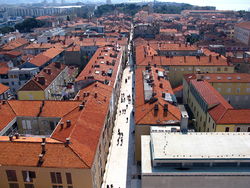 | Zadar is a city in Croatia on the Adriatic Sea. It is the centre of Zadar county and the wider northern Dalmatian region. Zadar is a historical center of Dalmatia as well as the seat of the Roman Catholic Archdiocese of Zadar. Zadar faces the islands of Ugljan and Pašman, from which it is separated by the narrow Zadar Strait. The promontory on which the old city stands used to be separated from the mainland by a deep moat which has since become landfilled. The harbor, to the north-east of the town, is safe and spacious. Most popular parts of city Zadar are: Kopnena vrata (Landward Gate) , Morska vrata ("sea gates"), St. Donatus' Church (a pre-Romanesque church from the 9th century) and Roman Forum |
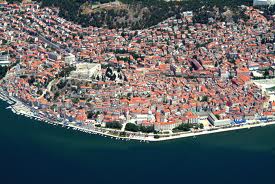 | Šibenik (Croatian pronunciation: [ʃîbe̞niːk]) is a historic town in Croatia, located in central Dalmatia where the river Krka flows into the Adriatic Sea. Šibenik is a political, educational, transport, industrial and tourist center of Šibenik-Knin county. In Croatian, the town is known as Šibenik, in Latin as Sebenicum, in Italian as Sebenico, in Hungarian as Sibenik, and in German as Sibennig.Most popular parts of city Šibenik are: St. Nicholas Fortress , St. James's cathedral. |
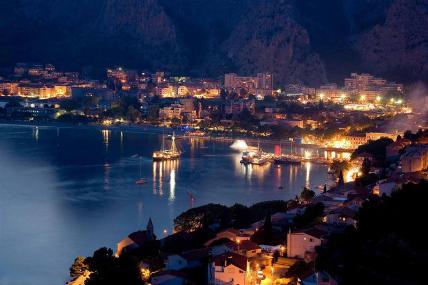 | Omiš was well known in the past by the Corsairs of Almissa (Omiški gusari) whose Sagittas (ships) (Genitive case: Sagittae, translated as The Arrow), brought fame to them because they were built for attack and fast retrieval into the mouth of the Cetina River, protecting the town from foreign invaders. At a very early date, neighbours of the Corsairs of Almissa, the highlanders of thePoljica Principality (Poljička Republika), became their friends and allies. This allowed them to harass the seaborne trade, without fear of a sudden attack from inland. In the Priko neighborhood, on the right bank of the Cetina River, stands the site with the most historic significance: the pre-Romanesque Church of St. Peter (Crkva Sv. Petra) from the tenth century A.D. This single-naved edifice, with a cupola and apse, was used in the 18th century as a Glagolithic seminary for novice priests. |
Historical monuments:
- Church of St Euphemia by the coast on Brzet, from the early 6th century
- Mirabella Fortress (Peovica) from the 13th century
- Starigrad Fortress (Fortica) from the 15th century
- Renaissance church of the Holy Spirit from the 15th century
- Old cemetery, the 16th century or 17th century
- Parochial church from the 17th century
- Franciscan Monastery on Skalice from the 18th century


